
Medical Research - SMP Saddles
Medical Research
Cycling stresses the human body more than you think and can generate consequences that should be looked into. SMP’s medical research has reviewed sixty two international scientific publications which revealed that cyclists suffer many common problems and pathologies in various parts of their bodies:
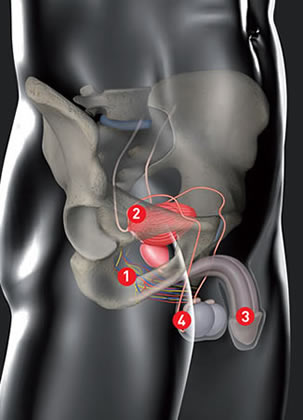
1. PERINEAL ZONE
TINGLING - due to the reduction in blood flow which is a consequence of prolonged local circulatory duct compression.
CHRONIC PAIN - found in between 50% and 91% of the cyclists considered; it is associated with genital-perinea desensitization and consequent moderate to severe erectile dysfunction in 13% to 24% of cases.
INJURIES - constant and prolonged contact between the saddle and perineal region can cause various types of injuries including calluses, ulcers, skin irritations or boils with folliculitis.
The most typical perineal nodular lesion is the so-called ‘biker’s nodule’ or the ‘third testicle’. Usually this nodule looks like an elastic-callus a few centimeters long, covered in skin. Surgical removal is normally indicated as primary therapy.
2. BLADDER AND KIDNEYS
HAEMATURIA - this consists of blood in the urine. Haematuria of exertion or traumatic origin, due to repeated micro-traumas to the bladder and kidneys, is directly proportionate to the duration of physical activity.
3. PENIS
PRIAPISM - due to a more copious and abnormal blood flow into the corpora cavernosa of the penis and consists of lasting painful erection. It is consequent to vascular trauma with the formation of arterial-venous fistula.
4.TESTICLES
PSA SERUM VALUES - after cycling, probably caused by compression of the saddle on the perineum region and thus also on the prostate gland. Cyclists with prostate cancer and those with PSA serum levels over the norm, especially over the age 50, should be informed of this possible effect.
INFERTILITY - prolonged physical activity causes an increase in scrotal temperature which damages sperm generation and changes the hormonal axis of the hypothalamus-hypophysis-testicular axis.
TESTICULAR TUMOUR - significant increase in the risk of testicular seminoma in cyclists probably connected with repeated and frequent scrotal traumas; however other researchers, concerning this same question, prefer to emphasize how physical activity is a protective factor with regards to neoplasias and that this, to a certain extent, balances out the greater incidence of neoplasm in cyclists.
TORSION OF THE SPERMATIC CORD - association of this event with cycling is still controversial and debatable; the cause of torsion may be linked to an endoscrotal movement of the testicles while pedalling, accompanied by a vigorous contraction of the cremaster muscles.
5. FEMALE BODY
In the female body, from an anatomical standpoint, the neurovascular structures compressed by the saddle are the same as those in the male body. Thus women also suffer from problems and dysfunctions linked to cycling. The main and most frequent ones are anorgasmia, ulcerations and lymphoedema of the labia majora, urination difficulties, chronic perineal pain and haematuria.

Abstract below from "The Journal of Sexual Medicine"
70% of CYCLISTS, BIKE RIDERS and CYCLING HOLIDAYMAKERS, Abstract from: “Journal of Sexual Medicine” |
Development of a New Geometric Bicycle Saddle for the Maintenance of Genital Perineal Vascular Perfusion The Journal of Sexual Medicine July 2005 G. Breda, MD - N. Piazza, MD - A.Caruso, MD: Department of Urology, S. Bassiano Hospital, Bassano del Grappa (VI), Italy; V. Bernardi, MD: Department of Urology, SS. Giovanni and PaoloHospital, Venice, Italy; E. Lunardon, MD: Department of Anaesthesia, S. Bassiano Hospital, Bassano del Grappa (VI), Italy. |

Measurement of the pressure in the intestinal region through the penile transcutaneous oxygen pressure (PTCO 2 in mm / Hg) on an SMP saddle and on a saddle widely used by professional cyclists.
values after |
SMP
|
Other saddles
|
3 min |
49.4 |
25.3 |
10 min |
50.6 |
32.6 |
25 min |
52.2 |
28.5 |
CONCLUSIONS
Compression of the perineum area causes crushing of neuro-vascular structures with possible consequences on erectile physiology. Bicycle saddle geometry can be a determinant factor in reducing compression and, thus, is an important parameter to be considered and evaluated when choosing a saddle.
The results obtained demonstrate that SMP saddles guarantee higher penis blood flow and are now the best solution on the market for the highest performance with the greatest health benefits.


